

2024/25 projects
1. Anti-democracy Grifters: Mapping US Influencers Selling Russian State Propaganda
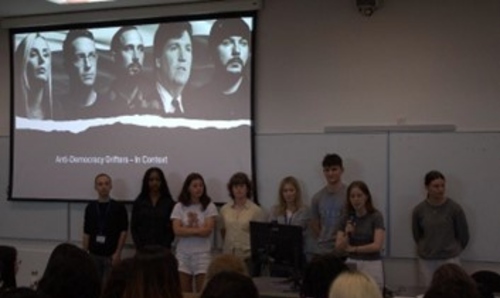
Purveyors of anti-democracy from a variety of different ideological milieus are enabled in digital contexts to come together creating polluted information, generating distrust in institutions, and reaping economic gain using influencer marketing. Simultaneously, recent research shows how state actors now leverage these same channels to interfere in democratic elections. A recently announced US Department of Justice (US DOJ) investigation into Tenent Media (TM), alleging multiple TM influencers have taken large sums (USD 2+ million) from Russian operatives to spread propaganda, shows that these two strands of anti-democratic information operations can be (and likely have been) linked. Moreover, several of the indicted influencers are also linked to promoting far-right extremist, anti-gender extremist, and white supremacist extremist ideologies, which are similarly rife with anti-democratic beliefs. The integration of hostile states and extremist digital cultures poses real concerns as influencer networks such as these have had material impacts on socio-political life, including violent post-electoral mobilisations in the US and Brazil and fomenting conspiracy-linked mobilisations internationally (e.g., #SavetheChildren rallies, and so-called “trucker convoys,”).
By participating in this project, students learnt about the persuasive effects of digital media and digital economies of circulation at their intersection with democratic polarisation and the spread of extreme ideologies. This includes how influencers and influence networks sell ideology under the guise of political punditry along with merchandising of products or advertising. Student work contributed to our understanding of ways that influencer capacities and capabilities present a relatively low cost, high impact avenue for state-sponsored attacks on democracy.
The project employed a discursive-contextual visual method (DCVM), developed by the project lead which provides a step-by-step guide to conducting grounded, interpretive analysis of visual content. Students received training in ethical clearance of research, researcher safety online, and on applying the DCVM. Students worked with guidance to collect content for analysis from accounts designated by the Project Lead. After that, students analysed the discrete corpus of content gathered, and met as a group to talk through this layer of coding. Following that, we used our corpus of coded materials to develop our mapping of how the selected influencer accounts are “selling” anti-democracy. Student project outputs were used to co-write blog posts for the VOX-Pol Network on aspects of our research findings, along with USP outputs.
Project lead: Dr Ashley Mattheis
2. Data Visualisation of (volcanic) hazard narratives and mythology
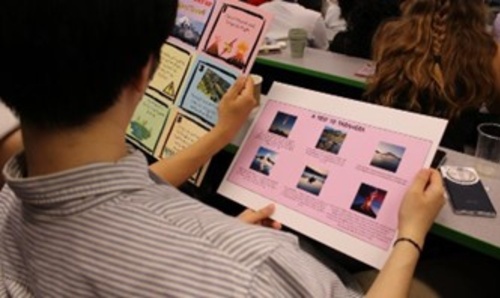
Thinking of traditional stories or narratives may lead to thinking of Greek gods such as Hera or Zeus (especially if you have watched the Netflix episode KAOS). However, some of these local stories or narratives follow a different purpose. In Hawaiian culture the goddess of fire Pele- honua-mea represents an understanding of the natural environment. Her tempestuous anger signifying eruptive activity as a warning to local communities. Or to the Taino culture
(indigenous Caribbean population) the god Juracan, from which the word ‘hurricane’ derives, represents the controller of weather and wind and is widely linked to destruction. Why have these stories developed in culture? What value does this local knowledge represent in modern- day disaster resilience?
Such stories often exist to help communities live in unison with their environment. The purpose may be to create or install fear and ward people from potentially dangerous situations or areas. Alternatively, these narratives help develop an emotion connection to embed adaptive resilience and sustainability with the environment. These form an important part of societal learning and awareness and provide grounding for disaster risk reduction.
These narratives may be passed orally as stories or written as songs or tales. With the rise of our digital age of mobile technology representation of these stories is limited to the written form. As such data visualisation and mapping offers the opportunity to create, collate and engage with such material.
Therefore, this project aimed to give students the opportunity to both understand the role of these narratives and their role in community resilience building and evaluated of existing methods of data visualisation. This led to an opportunity to create a digital and interactive resource collating this narrative for regional ocean island communities. This resource targeted learning for students at secondary school level and for community engagement to explore the opportunity to create resilience.
Project Lead: Dr Martin Parham
3. Dating Futures in the Digital Age
Finding romantic or sexual partners has long been mediated by diverse technologies, from love letters to personal ads to dating and hook-up apps. The technologies influence the practices of self-presentation, intimacy and community, online and offline, and they delimit what is required, possible and expected when engaging in dating.
Recent rapid developments in digital technology affect virtually all aspects of life and dating is no exception. In this project, participants critically reflected on the future of dating as impacted by technological change. They learnt about and examine the latest technological innovations, especially those related to (1) the use of big data analytics and algorithms for matchmaking (e.g. as employed by eHarmony and OkCupid), (2) dating in Extended Reality, XR (e.g. in Metaverse), and (3) dating an AI companion (e.g. the Replika chatbot).
Students researched the specific case studies in small groups, following the cultural studies methodology developed for the analysis of the Sony Walkman (du Gay et al., 2013 Doing Cultural Studies: The Story of the Sony Walkman). This involved the analysis of the history of their technology of choice, its ownership structure, business model, governance practices and marketing materials as well as its technological affordances, content and use.
Additionally, drawing on critical future studies (Goode & Godhe, 2017 Beyond Capitalist Realism – Why We Need Critical Future Studies), students critically reflected on the imaginations of dating futures and the role of technology in those imaginations. How is the future of dating being imagined and by whom? What are the potential positive and negative consequences of heavily mediatized future dating practices? Will there be no way of dating in the future without the involvement of advanced digital technologies? Students answered those questions collectively by comparing the analyses of their case studies.
The outcome of the project was a presentation in a metaverse platform and at the in-person showcase. With other students and the leading academic, students discussed the possibility of creating an additional public-facing output, for example, a blog post, podcast or vlog.
Project Lead: Dr Łukasz Szulc
4. How to conduct Corpus-based research in spoken language
Studying the language of written texts is relatively straightforward: Collect texts, identify linguistic expressions of interest, and analyse results. However, the study of spoken language presents unique challenges. Speech does not come in segmented categories but must be transcribed, requiring theory and significant effort. Many aspects of language are exclusive to the spoken mode, such as errors or fillers (e.g., "uhm" and "you know"), which must be carefully treated within explicit transcription guidelines. The processes involved in uttering spoken words are multifaceted and complex, involving factors like attention to speech, participants, dialect, and more. In this Undergraduate Scholars Research Programme, students learnt to address these challenges and examine spoken language professionally and competently.
Students worked in teams throughout the project, supporting each other with advice and collaborating on transcription tasks. They became familiar with:
- The relevance of theoretical transcription guidelines, including issues such as time stamps, tokenization, disfluencies, and spelling conventions;
- The state-of-the-art "tier transcription system," with different levels for speakers, extra- linguistic noises, comments, etc., associated software, and text and audio formats;
- Methods for finding speech samples from public sources;
- The importance of proper speaker documentation, including dialect, age, social, individual, and situational variables;
- Basic analysis techniques for studying linguistic features predominantly found in speech (e.g., quotative "be like," the "is is" construction, or the use of emphatic "literally").
Each student contributed two transcriptions: one 5-minute and one 15-minute speech sample. This collaborative effort resulted in the main project outcome – a professional, publicly accessible corpus of high-quality transcripts. Students then used this corpus to analyse one feature of spoken language of their choosing.
Throughout the project, teams met regularly to share insights, troubleshoot challenges, and provide peer feedback. The programme culminated in a final showcase presentation, which the teams designed and delivered together, highlighting their collective findings and individual analyses.
Project Lead: Dr Richard Zimmermann
5. Investing the Effects of Cultural Activities on Students’ Wellbeing
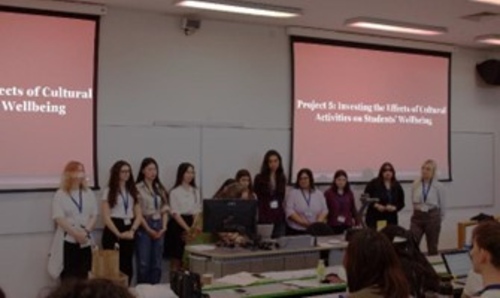
At the University of Manchester (UoM), over 19% of students identify as DASS (UoM, 2024), with many others experiencing academic stress or depression. This project brings students from diverse cultural backgrounds together to work on a research project focusing on the impact of participation on culturally specific activities on wellbeing. The aim of the project was twofold: It sought to foster intercultural communication and mutual understanding among students, by bringing students from diverse backgrounds together to work on a project. Those students investigated the impact of cultural activities, and specifically those from non-western cultures, affect wellbeing.
This project was a hands-on, experiential approach to research, combining academic research into cultural practices with personal reflections on lived experiences. The output from this project was an immersive experience that showcases a selection of cultural wellbeing practices and their impact on wellbeing.
Students investigated:
- Differing approaches to wellbeing and the data on the impact of participation in such practices, in order to compare approaches and discover what the data reveals about these approaches. (i.e. Eastern v. Western approaches to medical practices);
- Cultural practices to foster wellbeing, in order to explore the impact of specific practices on wellbeing (i.e. tea/coffee/alcohol, Tai Chai/yoga, meditation, massage etc.);
- Effects of participation on wellbeing (i.e. survey data, qualitative research, personal reflections on physical and mental health before and after participation).
The aim of the USP was to improve the students’ research skills but also to help them develop their future skills – that is, the so-called human skills, digital and AI skills they would need to thrive.
Project Lead: Dr Minjie Xing
6. Mapping the Environmental Costs of AI
The environmental impacts of artificial intelligence (AI) are huge and growing. This project offers interested students the opportunity to investigate the rising environmental costs of building, maintaining, and using AI. The project contributed to cutting-edge academic, tech, activist, and policy work seeking to determine, and map out, the various associated environmental impacts of AI – much of which currently remains undetermined, hidden, partial, or unknown altogether.
The project aimed to produce an Environmental AI (EAI) Database collating the various costs of different AI and ML firms, products, and services like OpenAI’s now widely-used ChatGPT. These environmental costs are typically spread along the so-called AI ‘pipeline’ from the collection of user data to ‘model inference’ – the technical term for using a ML-driven service. The project took inspiration from various tech database initiatives, including the AIAAIC Repository, an ‘independent, open, public interest resource detailing incidents and controversies driven by, and relating to AI, algorithms, and automation’ (AIAAIC 2024). The project built on work in media
studies, science and technology studies (STS), human geography, computer science, and critical accounting studies that have variously examined the environmental costs of digital technology in different, often innovative ways.
The EAI Database contributed to pedagogic work on a PGT course unit run by Sam Hind, DIGI61112 AI, Algorithms and Society. In particular, it contributed to a week on ‘AI and the Environment' (March/April), with the database being used for seminar activities. The project also acted as a proof of concept for research work to be conducted by myself and Gareth Fearn, a Leverhulme Early Career Fellow at the University of Manchester (Geography), into the environmental impact of AI and ML in the energy sector. Students on the project were therefore able to demonstrate their impact on real-world pedagogy and academic research. The skills and competencies gained are hugely valuable to companies, governments, and policy organizations in, and connected to, the global tech industry.
Project Lead: Dr Sam Hind
7. Researching Arts Value: A Multidimensional Socio-Economic Approach
How do we measure the value of arts and culture? Poets and philosophers can tell us in words, but are there other ways to mensurate the value of the arts? What happens if we try to express that value as a measurement of social/individual economic progress beyond the traditional quantitative approach made by economists (i.e., impact on GDP, employment, etc.)? Can we use different measures to express the value of the arts for society and the economy?
In this project, the research group collaboratively explored innovative ways to identify and describe the multidimensional contribution of arts and cultural practices to economic development. Working in small teams, students shared insights and methodologies whilst developing a comprehensive understanding of artistic value measurement. The team built upon each other's strengths and perspectives through regular group meetings and collaborative online workspaces.
For our purposes, the study of the economy was treated as a social science and focus on elements such as gender, race, social backgrounds, equality, distribution, and pro-society policies that contribute to improving quality of life. Similarly, development in this context refers to the sustainable improvement of individual and social well-being as a result of contributions in and by the arts sector and cultural practices.
The group's research activity on this project began with a focused, non-exhaustive literature review on multidimensional human and economic development, well-being, substantive value
for economics, and political economy of cultural and creative industries. Team members divided these areas and met regularly to synthesise findings and develop shared insights.
Next, using the toolkit of multidimensional indicators produced by Dr Leandro Valiati in partnership with 30 Arts Organisations in Brazil and the UK (www.culturalvalue.org), the group collaboratively created a small set of indicators that express the dimensions found in their literature review. The indicators—stemming from secondary data, structured interviews, or surveys—functioned as examples of the impact of the arts and culture on socio-economic development from a multidimensional perspective.
Finally, students tested these indicators in a case study, working together. This collaborative approach allowed team members to share responsibilities for data collection, analysis, and presentation of findings.
Participating in this group project familiarised the participants with the basic notions of heterodox economic development and well-being theory, helped them become familiar with research instruments and their applications, and helped them develop basic data analysis skills. Through collaborative work, they also enhanced crucial future skills essential for the modern workplace.
Project Lead: Dr Leandro Valiati
8. Translating literary text for publication
What is a translator’s pitch? What is a translation slam? What does copyright mean for translators? What does revising a translation for publication involve? And what about questions of ‘domesticating’ or ‘foreignising’? How do translators (and editors) approach controversial/sensitive language? What can AI do for literary translation? In this project, students were invited to reflect on the practice of literary translation both from a theoretical and a practical perspective.
From a theoretical perspective, literary translation has increasingly been confronted with pressing power asymmetries in the publishing world. Some of these are of a linguistic nature (national vs regional; global v local), others depend on cultural, historical or economic factors (dominant vs marginal; Eastern/Western). Insights furnished by scholars in the fields of gender studies, and post and de-colonial studies were touched upon to understand the nature of hegemonic discourses (and practices) on the translation and publication of literature in a selection of countries.
Participants were asked to comment on these issues when choosing a translation case study in their culture and language combination (for ex. contemporary Spanish poetry into English; English-language children’s classic into German, etc.), and to produce a scholarly/professional piece (pitch; translation & commentary; retranslation; etc.) for publication. Each case study was a collaborative effort involving at least two students.
The aim of the project was to provide students with an opportunity to develop professional competences in the field of translation and publishing. Students were asked to collaborate in various capacities. In addition to translation, other roles which are increasingly part of a translator’s skill set is that of peer-reviewer, copyeditor, literary scout. For the purposes of this project, some students may have preferred to take part as co-editors rather than translators, or copyeditors or cover designers. The end product of the project was the publication of the second Student Issue of the journal of literary translation practice Il Pietrisco, where the case studies appear and all these roles were essential.
In addition to working with Monica Boria and the co-editor of the journal, Prof Ángeles Carreres, the team involved other staff from Modern Languages and Cultures, as well as professional translators.
Project Lead: Monica Boria
9. Ukrainian Art in Migration
How are artists affected by conditions of migration and displacement? How do they creatively respond to the new environment? What discourses around cultural labour do they construct? What is the role of diasporic community in the construction of meaning away from home? And what is the role of memory?
In this project, students examined the intersection of art and migration through the case study of Ukrainian artists who relocated to England’s North West following Russia’s full-scale invasion in February 2022. The experience of migration often prompts artists to renegotiate the boundaries of culture, place, and belonging, as they grapple with identity fragmentation and hybridity. Through visual arts, performance, literature, and other mediums, artists not only reflect on and critique the sociopolitical events that cause migration but also forge new spaces for solidarity, memory, and hope among diasporic communities. This interplay underscored how art is both shaped by, and shapes, the migration experience, serving as a bridge across cultural and geographical divides, and as a conduit for exploring identity, loss, memory and resilience.
With the support of the Ukrainian Institute, with which the project lead regularly collaborates, students analysed the art (in visual, musical, or written form) produced by migrant Ukrainian artists in the North West, including how the new conditions, affected by war and displacement, have contributed to shape artistic activity and discourses around creative labour, community and memory.
By taking part in the project, students got involved in mapping out activities of Ukrainian migrant artists, as well as in conducting interviews with artists, participant observation, and audience surveys. At the end of the project, students co-wrote a substantial piece of work detailing their findings, which will be proposed for publication to a student or academic journal, as well as a short article for the general public, which will be hosted on a university platform.
Apart from enhancing theoretical knowledge around creative labour, migration and the Ukrainian conflict, the project aimed to provide students with transferable skills, including in communication, data gathering and processing, critical thinking and other WEF-identified top skills.
Project Lead: Dr Marco Biasioli