
Classics, Ancient History, Archaeology and Egyptology
Course unit information and programme structures for Classics, Ancient History, Archaeology and Egyptology.
Welcome to the newly-combined Department of Classics, Ancient History, Archaeology and Egyptology, where an interdisciplinary culture provides great support for learning.
The Department comprises academic staff, a dedicated technician, library, common room, and labs, all to be located together in the Samuel Alexander Building.
While preserving what is importantly distinctive in each subject area, the newly-combined Department opens up exciting new collaborative possibilities in all activities, from outreach to employability.
Please browse below for course unit information and programme structures for our campus-based programmes.
Programme structures
BA (Hons) Ancient History
- L1 Ancient History Programme Structure
- L2 Ancient History Programme Structure
- L3 Ancient History Programme Structure
BA (Hons) Ancient History and Archaeology
- Level 1 AHA programme regulations
- Level 2 AHA programme regulations
- Level 3 AHA programme regulations
BA (Hons) Ancient History and History
- Level 1 Ancient History and History programme structure
- Level 2 Ancient History and History programme structure
- Level 3 Ancient History and History programme structure
BA (Hons) Archaeology
- Level 1 Archaeology programme regulations
- Level 2 Archaeology programme regulations
- Level 3 Archaeology programme regulations
BA (Hons) Archaeology and Anthropology
- Level 1 Archaeology & Anthropology programme regulations
- Level 2 Archaeology & Anthropology programme regulations
- Level 3 Archaeology & Anthropology programme regulations
BA (Hons) Archaeology and History
BA (Hons) Classical Studies
- L1 Classical Studies Programme Structure
- L2 Classical Studies Programme Structure
- L3 Classical Studies Programme Structure
BA (Hons) Classics
BA (Hons) Latin & English Literature
BA (Hons) Latin & Linguistics
BA (Hons) Latin & Spanish
- L2 Latin & Spanish Programme Structure
- L3 Latin & Spanish Programme Structure
MA
UGCert Egyptology
UGDip Egyptology
Reference collection
The Classics and Ancient History reference collection is housed in Samuel Alexander S.2.1a. The room is usually open throughout the working week (normally 8am to 8pm, Monday-Friday).
All members of the School are welcome to use the room and its resources, but Classicists and Ancient Historians will be particularly interested in its holding of books: these comprise around 2200 volumes, including Greek and Latin texts, dictionaries, reference works, translations, and some key works of modern scholarship. Books may be consulted in the room, but must not be borrowed.
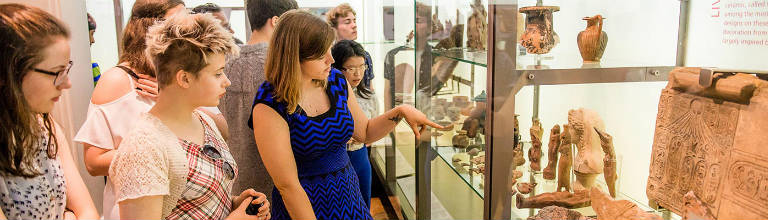
We also have an extensive Archaeology teaching collection of artefacts, ecofacts, human and animal remains and artefact replicas.
Our teaching collections include the diverse, eclectic and extensive Brice Collection, which has everything from 20th century coins, to middle Palaeolithic lithics, with material from almost every part of the world, and including a selection of geological examples as well experimental glass knapping.
History
The collection has been built up in part thanks to generous gifts and bequests, as well as with funds provided by the John Rylands University Library.
In summer 2001, the collection was greatly amplified by the transfer of books from the Departmental Library at Keele University; more recently, the ancient historical holdings of the Philip Haworth Library have also been transferred to this collection.
Reference tools
Encyclopaedias
- Oxford Classical Dictionary (Shibboleth required if accessing off-campus)
- Perseus, the most thorough online encyclopaedic Classics site, based at Tufts University in the US; an alternative (slightly less comprehensive) presentation of the same data is available from Chicago. Useful tools (both searchable) include:
- The Perseus Encylopaedia
- H. T. Peck's Harpers Dictionary of Classical Antiquities (1898)
Other online reference resources
- Diotima: materials for the study of women and gender in the ancient world
- Ancient World Mapping Center
- Suda online
Electronic journals in Classics (UoM library)
The majority of the links below will work only if you log in via a computer which is registered to access the journals via The University of Manchester Library (eg staff and student machines on campus in The University of Manchester).
Remote access to most of these resources is available by using the 'Shibboleth' login system, or by running the University's Virtual Private Network.
(This list is not exhaustive, but is meant as a quick reference guide. You can check the accessibility of other journals from the E-journals start page on the The University of Manchester Library website.)
Full-Text E-Journals in Classics
- Acta Classica 1958-2000 [PCI]
- American Journal of Archaeology 1897-2007 [JSTOR]
- American Journal of Philology 1880-2010 [JSTOR]
- Année Epigraphique 1889-2006 [JSTOR]
- Annual of the British School at Athens 1894-2010 [JSTOR], Annual of the British School at Athens, 2008- [CUP]
- Ancient Narrative 2000- [WWW - available everywhere]
- Antiquity 1927- [Antiquity Publications]
- Arethusa 1968-2000 [PCI], Arethusa 1996- [Project Muse]
- Britannia 1970-2010 [JSTOR], Britannia 2005- [CUP]
- BMCR [WWW - available everywhere]
- Bulletin de Correspondance Hellénique 1877-2000 [WWW - available everywhere; Supplements and Indexes also available]
- Classical Antiquity 1969-2000 [PCI]; Classical Antiquity 1982- [JSTOR]
- California Studies in Classical Antiquity 1968-1979 [JSTOR]
- Classical Bulletin 1925-2000 [PCI]
- Classical Journal 1905-2010 [JSTOR]
- Classical Philology 1906-
- Classical Quarterly 1907-2008 [JSTOR], Classical Quarterly 2001- [CUP]
- Classical Review 1887-2008 [JSTOR], Classical Review 1998- [CUP]
- Classical World 1907-1996 [PCI], Classical World 1957-2010 [JSTOR]
- Classical Weekly 1907-1956 [JSTOR]
- Classics Ireland 1994-2010 [JSTOR]
- Dictynna 2004- [WWW - available everywhere]
- Emerita 1933-2000 [PCI]
- Glotta 1909-2012 [JSTOR]
- Gnomon 1925-2008 [JSTOR]
- Greece & Rome 1931-2008 [JSTOR], Greece & Rome 2001- [CUP]
- Greek, Roman and Byzantine Studies 1958-2000 [PCI]
- Harvard Studies in Classical Philology 1890-2010 [JSTOR]
- Helios 1999- [Gale], Helios 2007- [Project Muse]
- Hermes 1866-2009 [JSTOR], Hermes 1866-2000 [PCI]
- Hesperia 1932- [JSTOR]
- Historia 1950-2008 [JSTOR]
- Histos 1997- [WWW - available everywhere]
- International Journal of the Classical Tradition 1994-2009 [JSTOR]
- Journal of Hellenic Studies 1880-2010 [JSTOR], Journal of Hellenic Studies 2009- [CUP]
- JHS Archaeological Reports 1954-2010 [JSTOR]
- Journal of Philology 1868-1920 [PCI]
- Journal of Roman Studies 1911-2010 [JSTOR], Journal of Roman Studies 2009- [CUP]
- Klio 1901-2000 [PCI]
- Leeds International Classical Studies 2002- [WWW - available everywhere]
- Materiali e discussioni per l'analisi dei testi classici 1978-2008 [JSTOR], Materiali e discussioni per l'analisi dei testi classici 1997- [password required: consult the JR's password list for details]
- Memoirs of the American Academy in Rome 1915-2008 [JSTOR]
- Mnemosyne 1852-2000 [PCI], Mnemosyne 1852-2008 [JSTOR], Mnemosyne 1948- [Brill]
- Papers of the British School at Rome 1902-2010 [JSTOR], Papers of the British School at Rome 2008- [CUP]
- Philologus 1846-2000 [PCI]
- Phoenix 1946-2010 [JSTOR]
- Phronesis 1955-2000 [PCI], Phronesis 1955-2008 [JSTOR], Phronesis 1955- [Brill]
- Polis 1998- [Ingenta]
- Quaderni Urbinati di Cultura Classica 1966-2008 [JSTOR]
- Ramus 2014- [CUP]
- Revue de philologie, de littérature et d'histoire anciennes 1845-2000 [PCI]
- Rheinisches Museum 1900-2009 [WWW - available everywhere], Rheinisches Museum 2010- [J.D. Sauerlaender's Verlag]
- Studi romani 1954-2000 [PCI]
- Symbolae Osloenses 2000-2012 [Ingenta]
- Transactions of the American Philological Association (1897-1972) [JSTOR], Transactions of the American Philological Association (1974-) 1974-2008 [JSTOR], Transactions of the American Philological Association 2000- [Project Muse]
- Zeitschrift für Papyrologie und Epigraphik 1967-2010 [JSTOR], Zeitschrift für Papyrologie und Epigraphik 1988-2000 [WWW - available everywhere]
Computers and external resources
The Faculty of Humanities offers a wide range of computing facilities for students within the Samuel Alexander, Humanities Bridgeford Street, Mansfield Cooper, Dover Street and Manchester Business School buildings.
You can also access a range of resources at institutions on campus and beyond, including John Rylands Library and Manchester Museum.
Learn more about facilities for Classics, Ancient History, Archaeology and Egyptology students.
References
Staff are happy to provide references for current and past students whom they have taught (as long as they are available and are given plenty of notice!).
Normally, the correct person to contact is your Academic Advisor, but you may prefer your Dissertation supervisor, or the director of a level 3 module you have enjoyed, especially if you are completing an application for graduate study.
First, check the member of staff's availability and willingness to write a reference by e-mail before listing them as a potential referee on a grant or job application. Make them aware of what you are applying for, why and when: let them know key deadlines and how they will be contacted. Second, they will need:
- an up-to-date CV (including degree results and highlights, such as your dissertation topic);
- a copy of your letter of application (where relevant) and;
- the details of the job.
For an academic reference, they will also need a full transcript of your results from Levels 2 and 3. These are available on request from the School of Arts, Languages and Cultures Undergraduate Office.