
2020/2021 projects
1. Women’s autobiographical filmmaking
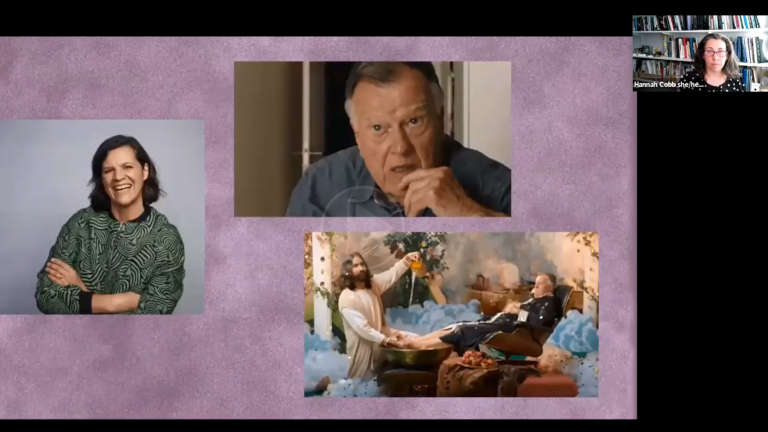
Autobiographical filmmaking refers to films created by filmmakers that tell stories about their lives, experiences and memories. These may be truthful or partially fictionalised, remembered clearly or misremembered, or a combination of these, usually in ways that also explore how film as a medium can do this — a form of practice-as-research, if you like. The students explored the following questions: Is there / can there be a gendered nature to this mode of filmmaking / life-remembering? Do women filmmakers tell different stories about their lives from men, or do they do so in a different way? The intention was not to enforce a gender binary but to explore how a critical dialogue may be enacted through the mode of the autobiographical film.
The students were split into two groups for this project. For more information on Group 1’s work, you can watch this video on Memory and Trauma in Women’s autobiographical films and for Group 2’s work, you can read about their plans for the ‘Her Story’ Film Festival.
Project Lead: Dr Felicia Chan
Students involved in this project: Ava Innes, Avtarnika Sharma, Caitlin King, Daniel Collins, Hannah Mitchell, Imogen Smith, Niamh Burke, Philippa Carew and Polly Haworth
2. Posthuman Pedagogies – what does the digital do?
A range of recent philosophical approaches have argued that rather than seeing humans as being at the centre of everything, as active subjects framed against a backdrop of passive objects, it is more fruitful to understand how people and things mix and merge, and how this is a constant and ever shifting process. These approaches, which fall roughly under the philosophical schools of New Materialism or Posthumanism, might sound abstract when described this way, but as some of the leading thinkers in this area have argued, their application for rethinking feminism (Braidotti), the environment (Tsing) and capitalism (Deleuze and Guattari) amongst other things, are phenomenal.
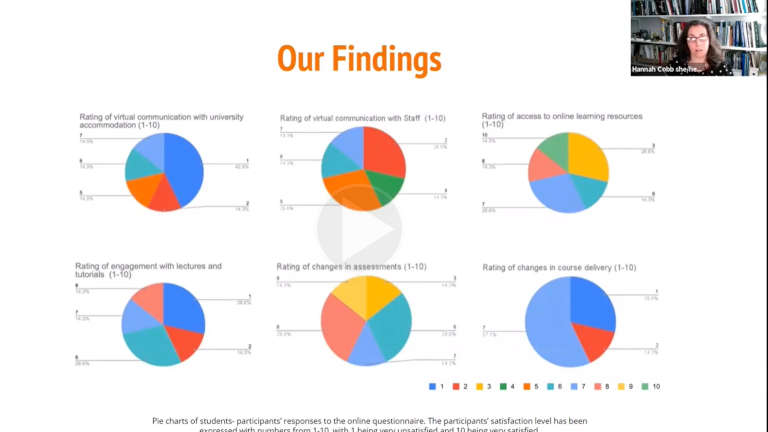
In this project students explored how these ideas have value for understanding pedagogy (that is the processes and practices of teaching and learning). In particular, they considered how a posthuman approach might be of value for examining the role of the digital in Higher Education. Using our current state of online and blended learning as the basis for our analysis we asked; what does the digital do? Does it democratise learning? Or the opposite? Does it allow the mixing and merging of people and things in new ways? And if so, how? Does the use of online learning and digital technologies allow us to push the boundaries of convention and develop more politically and pedagogically radical teaching and learning? Or does it “black box” some modes of enquiry? The aim of this project was to consider these questions and more. As well as our final presentation for the UG Scholars programme, we also worked towards developing an article for submission in the International Journal of Educational Research.
For more information about this project, you can read about the student’s research on Posthuman Pedagogy and DASS, Digital Poverty at the University of Manchester and what the digital does to international students.
Project Lead: Professor Hannah Cobb
Students involved in this project: Alexis Chiaramonte, Aude Onivola Rajaona, Elisa Cardamore, Isabel Fountain, Katie Bray and Lauren O’Connor
3. Visual Storytelling for Language Documentation
How many languages do you think there are? While counting languages is hard, Simons & Fenning (2018) estimate the number of languages currently spoken on the planet at around 7,000 languages, a number that speaks to the incredible diversity of what is possible within the human mind. It is also a number that might make you wonder whether there’s anything that all of these languages have in common.
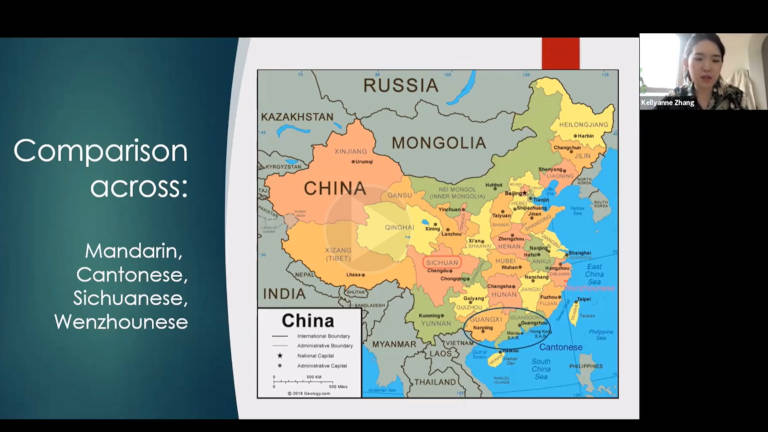
Worst-case scenarios predict that 90 percent of these languages will have become extinct by the end of this century (Krauss 1992). At the same time, we lack written and recorded data for a majority of the existing languages in the world (Velupillai 2012). Projects aimed at documenting the languages of the world have arisen in response to this crisis of language loss. Language documentation is the project of collecting data from understudied languages with the goal of describing the language’s grammar and use. The linguistic data that is collected can take many different forms, grammatical description, traditional narratives, oral histories, songs, and so on. As such, language documentation is an interdisciplinary enterprise that can benefit from insights from anthropology, musicology, and the visual arts. Given both the urgency of language documentation efforts and the interdisciplinary nature of documentation projects, we proposed a UG Scholars course on this topic.
Topics discussed included the factors leading to language loss, the ethics of carrying out documentation projects in marginalised language communities, best practices for language documentation, and pros and cons of particular documentation methods. We ultimately focused on one particular methodology: the use of visual storyboards to collect short narratives in a target language, typically with the goal of studying a particular component of the language’s grammar (Burton & Matthewson 2015). We trained students in how to develop, test, use and publicise storyboards for language documentation. This involved working collectively with other students in the course to test and apply the storyboards to the languages that they speak.
For more information about this project, view the slides from the group’s presentation.
Project Leads: Dr Vera Hohaus and Dr Margit Bowler
Students involved in this project: Jiayue Yang, Bela Thomas, Haoran Zhou, Isabella Wetson, Juliet Whitehouse, Zhang Xinhui, Xingchen Guo, Youlan Liao and Ziyue Xu
4. The Language of Alienness in Science Fiction
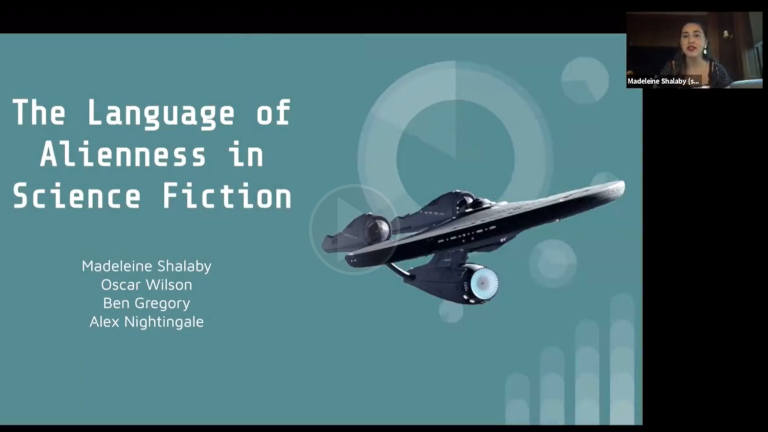
Extra-terrestrial characters in the Science Fiction genre often play an important narrative role in representing the Other, and the language used by and for these characters helps to construct that sense of alienness. This practice can in turn shed light on how linguistic structure is represented in the mind, and what kinds of implicit knowledge language users are able to draw on. For example: do names that sound ‘alien’ to English speakers use sound sequences that are rare in English, or sound sequences that violate more universal principles of phonological markedness?
This project took an inter-disciplinary approach, welcoming contributions from a variety of perspectives and skill sets, and students were encouraged to identify (and come up with) specific questions within the broader project that interested them. Some of the ways that students were involved in the project included:
• Expanding and analysing a phonological corpus of alien names.
• Visual character design for experimental stimuli.
• Conducting online experiments to test specific questions about how linguistic structure creates alienness.
• Connecting with insights from literary and film studies.
• Sociolinguistic case studies and analysis.
The culmination of the project involved an element of science communication, helping to bring the insights of the project into the wider discourse of Science Fiction fandom. For more information about this project, view the project’s website.
Project Lead: Dr Wendell Kimper
Students involved in this project: Alex Nightingale, Alexander Harris, Benjamin Gregory, Madeleine Shalaby, Oscar Wilson and Zi Feng Ma
5. How the Story of Our Words Informs and Distorts Present Knowledge
We often use words to justify scholarly and scientific knowledge, aesthetic judgments, policy decisions or law that have a surprising and revealing history. Thus what these words meant in earlier generations may point to meanings that still linger, but are not on the surface, or they can point to changing attitudes. The story of words or phrases can show that terms of apparent description carry or have acquired unacknowledged ideological loads.
In this research project we selected terms that play a key but unquestioned role in a particular document for investigation, delving into their recent or earlier history. We did this in two ways: exploring some of the linguistic usages of earlier times, to develop a critical sense of semantic variety, changes 5 in usage, or cultural background. We also drew upon studies that provide a critical historical perspective on the field of knowledge, law, art or politics in which the text is located that you use as primary evidence. This allowed us to explore some of the unacknowledged contributions which word choices can make to a particular contemporary claim to knowledge or in a decision making process.
For more information about this project, view the project’s website.
Project Lead: Professor Alexander Samely
Students involved in this project: Brock Reeder, Zara Alansari, Natalia Galindo Freire, Theo Bennett, Yang Chen, Alexandra Birch, Amelia Hope, Eleanor Bootman, Guendalina Magnoni Stella, Isobel Dye and Leah Kinzer
6. How to conduct corpus-based research on spoken language
Paragraph about project?
Project Leads: Dr Richard Zimmerman
Students involved in this project: Brendan Cox, Jamie Lea Carter and Wenjing Shi
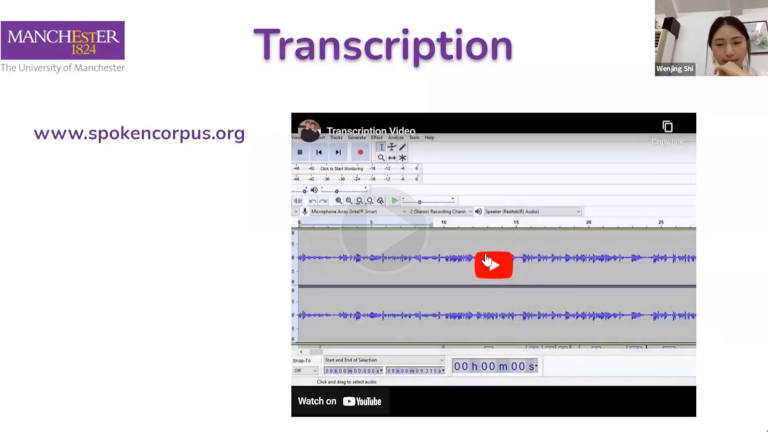
Studying the language of written texts is relatively straight-forward: Collect lots of texts, look for the linguistic expressions you are interested in, and investigate your results. The study of spoken language, however, is a whole different animal. First, speech does not come in objective categories, but must be transcribed. This is not a trivial task but requires some theory and great effort. Secondly, there are many aspects of language that are exclusive to the spoken mode, such as errors or fillers (think of all the uhms and you knows). Such difficulties must be treated carefully within an explicit framework. Thirdly, the processes in uttering spoken words are multi-faceted and complex, involving factors such as attention to speech (you speak differently when you read or talk to others), speech participants, dialect, and much more. In this Undergraduate Scholars Research Programme, students learnt how to deal with all of these difficulties and how to analyse spoken language professionally and competently.
Specifically, students became familiar with:
• The relevance of theoretical transcription guidelines, involving issues such as time stamps, tokenization, disfluencies and spelling conventions.
• The state-of-the-art “tier transcription system”, with different levels for speakers, extra-linguistic noises, comments, etc., associated software, as well as text and audio formats.
• Ways to find a speech samples from public sources.
• The importance of proper documentation of a speaker, including dialect, age, social, individual and situational variables.
• Basic analysis techniques in the study of linguistic features that are predominantly found in speech (e.g., quotative be like, I was like, “Yeah, definitely.”, the is is construction, But the reality is is nobody knows the answer, or the use of emphatic literally, I literally couldn’t open my mouth.).
Each student contributed two transcriptions of 5 minutes and 25 minutes of speech, resulting in the main outcome of this project – a professional, publicly accessible corpus of high-quality transcripts. In addition, students used the corpus to analyse one feature of spoken language of their choosing.
For more information about this project, view the slides from the group’s presentation.